
recent news & publications
Featured









Liberty Sales & Distribution and Progressive Pipeline Management (PPM) today announced a strategic partnership to expand access to Starline® Cured-In-Place Liner (CIPL) technology for natural gas utilities across key markets in the United States.
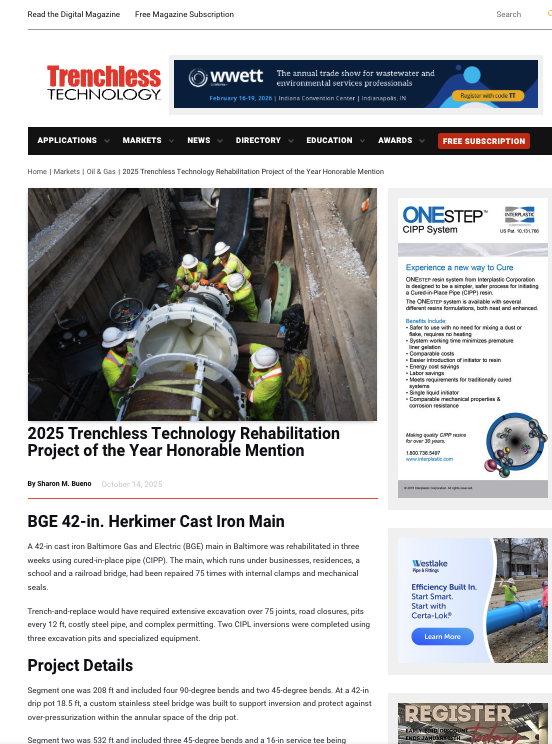
A Baltimore Gas and Electric 42-inch cast iron STARLINE® Cured-in-Place-Lining (CIPL) project was awarded Honorable Mention by Trenchless Technology magazine.
PPM was featured in Trenchless Technology for the BGE 42” CIPL - Honorable Mention Project of the Year.
PPM Awarded Trenchless Technology POY Honorable Mention for a Baltimore Gas and Electric 42-inch cast iron gas main rehabilitation project using STARLINE® Cured-in-Place-Lining (CIPL).
Platform Partners, a private investment company headquartered in Houston, has invested in Progressive Pipeline Management. PPM is a leading full-service, trenchless pipeline rehabilitation contractor that restores aging, damaged or leaking underground infrastructure.
For a cast-iron natural gas main, initial replacement options for Peoples Gas in Chicago seemed straightforward—plastic or steel pipes. Logistical, operational and system constraints led the utility to explore an alternative solution: trenchless pipe-lining technology.
Extending service life and upgrading the piping system of a University of Pennsylvania building in record time demanded strategic innovation, and swift execution. Due PPM and INTECH’s tight collaboration, the project was a success.
The 30-inch turnkey project in Brooklyn’s Gowanus Canal challenged what we thought was possible. There were several times we wondered, can it be done? There was nothing conventional about this project. The drawings showed a pipe configuration I had never seen.
After a previously installed liner failed, UV CIPP proved an ideal solution to rehabilitate a leaking 36-inch storm drain under a heavily trafficked road at a manufacturing facility in New Jersey. Interestingly, the leaking stormwater drainpipe had been lined a few years prior.
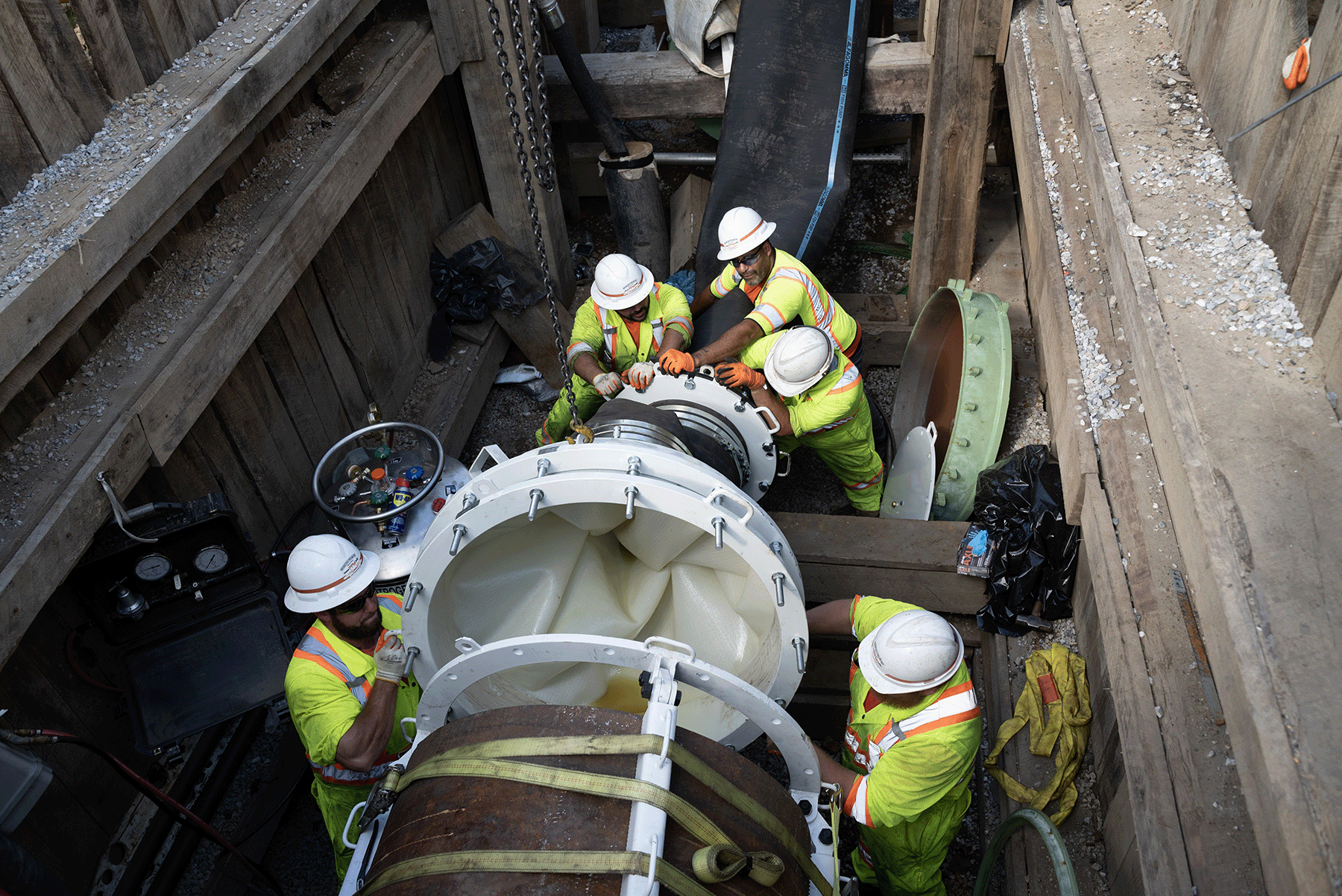
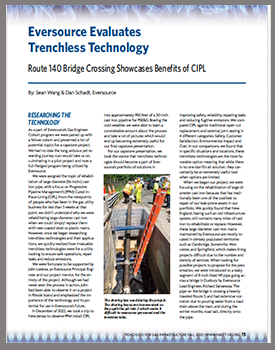
Eversource Engineers analyze PPM’s CIPL for a capstone project to rehabilitate a leaking bridge pipeline. Read about the role of trenchless technologies in Eversource’s portfolio of solutions for improving safety, reliability, repairing leaks and reducing fugitive emissions.
Steel gas mains come in a variety of specifics requiring a slightly different approach for reconditioning. A heightened level of awareness needs to be addressed in these three areas before the lining process begins.
Assessing ferrous pipe walls provides critical data to determine the condition and integrity of pipelines. When a utility needed to assess a section of a 20 inch cast iron main that runs under a railroad right-of-way, Broadband Electromagnetic Probe (BEM) accurately assessed the condition and the degree of corrosion or graphitization.
Starline® Cured-in-place-lining with carbon fiber SRS is an ideal solution to repair gas leaks within bridge pipelines. Of the 614,387 suspension bridges in the U.S, forty two percent are 50 years or older. In the Northeast, gas pipelines and bridges are typically 75 - 100 years old.
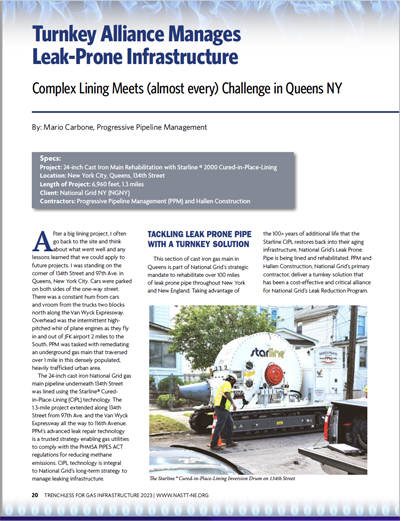
PPM and Hallen Construction, National Grid’s primary contractor, deliver turnkey and cost effective solutions to line a 24-inch cast iron gas main on a complex project in Queens, New York. The Starline CIPL technology is integral to National Grid’s long-term strategy to manage leaking infrastructure.
The award winning renewal of a 30 to 36 in diameter leaking high pressure (HP) gas main crosses a river in central New Jersey. It was affectionately named “The Mess” due to multiple complexities that required engineering and design solutions for a successful lining operation.
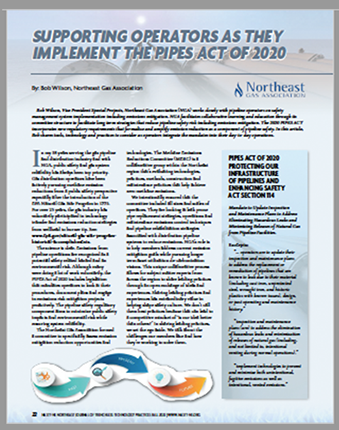
The 2020 PIPES ACT incorporates new regulatory requirements that formalize and amplify emission reduction as a component of pipeline safety. Bob Wilson shares tools, technology and practices to consider as operators integrate the mandates into their day-to-day operations.