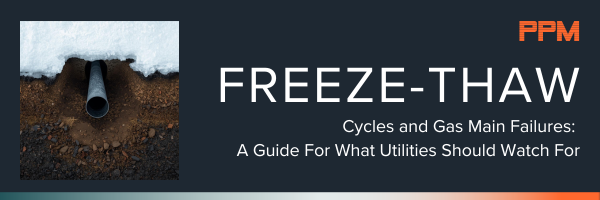
Each winter, natural gas utilities prepare for increased system stress caused by extreme weather. While freezing temperatures alone can introduce challenges to gas distribution systems, the most significant infrastructure failures often occur during the freeze–thaw transition, when ground conditions shift and pipelines experience unexpected mechanical stress.
Across North America, utilities frequently observe spikes in gas main leaks and failures in late winter and early spring, when frozen soil begins to thaw and settle. These seasonal conditions can expose vulnerabilities in aging infrastructure and require rapid response solutions to maintain safety and service continuity.
Understanding why freeze–thaw cycles impact gas pipelines, what warning signs to watch for, and how trenchless rehabilitation technologies like Starline CIPL can address failures is critical for operators managing distribution systems.
Why Freeze - Thaw Cycles Stress Gas Pipelines
Buried pipelines are constantly interacting with the surrounding soil environment. During extreme cold weather events, several factors combine to create stress on gas distribution infrastructure.
Soil Expansion and Settlement
When ground freezes, soil expands and can effectively “lock” pipelines in place. As temperatures rise and thawing begins, soil conditions change rapidly. Uneven thawing can cause differential settlement, placing bending or axial stress on buried pipelines.
Thermal Contraction of Metal Pipes
Steel and cast iron pipelines contract during extreme cold conditions. When temperatures rebound, the resulting movement can place additional stress on joints, couplings, and connections.
Demand and Pressure Variations
Winter demand spikes can increase system pressure fluctuations. Combined with physical movement of the pipe, this can contribute to weak points failing under stress.
Existing Corrosion or Structural Weakness
Many distribution systems contain pipelines that have been in service for decades. Corrosion, joint degradation, and material fatigue can leave pipelines susceptible to failure when seasonal stresses are introduced.
For utilities managing aging infrastructure, freeze–thaw cycles often act as the trigger that exposes underlying integrity issues.
Warning Signs Utilities Should Watch For
Freeze–thaw related failures do not always appear immediately after a cold event. In many cases, leaks and failures occur weeks after temperatures begin to rise.
Utilities commonly monitor for:
• Increased leak survey detections
• Pressure irregularities within distribution zones
• Reports of gas odor in service areas
• Evidence of ground movement or settlement near pipeline corridors
• Recurring issues at previously repaired sections of pipe
When these signs appear, operators must quickly determine the most effective repair strategy.
The Challenge of Traditional Pipeline Repairs
Historically, repairing a damaged gas main has required excavation and pipe replacement. While replacement remains necessary in some situations, excavation-based repairs can present several challenges:
• Extensive traffic and community disruption
• Long repair timelines
• High capital costs
• Difficult access in urban or congested environments
In many locations, pipelines run beneath major roadways, utilities, or developed infrastructure, making excavation complex and disruptive.
As a result, utilities increasingly evaluate trenchless rehabilitation technologies when responding to pipeline integrity failures.
Starline® CIPL: A Trenchless Rehabilitation Solution
One of the most effective trenchless technologies used in gas distribution rehabilitation is Starline Cured-In-Place Lining (CIPL).
CIPL involves installing a resin-impregnated composite liner inside the existing host pipe, which is then cured to create a new structural pipe within the original pipeline.
The result is a continuous, jointless composite pipe that restores structural integrity and seals defects within the existing main.
Key benefits of CIPL include:
• Structural reinforcement of weakened pipelines
• Sealing of corrosion defects and minor leaks
• Reduced disruption to communities and roadways
• Extended service life for existing infrastructure
Because the liner forms within the existing pipe, the process allows utilities to rehabilitate pipelines without full replacement.
Why Trenchless Rehabilitation Is Valuable for Winter Failures
When freeze–thaw conditions lead to pipeline failures, utilities must balance multiple priorities:
• Ensuring public safety
• Maintaining gas service continuity
• Minimizing disruption to communities
• Restoring pipeline integrity quickly
Trenchless rehabilitation technologies allow operators to address pipeline failures with significantly less surface disruption, often reducing project timelines compared to traditional replacement.
For winter-related failures, the ability to deploy rehabilitation solutions quickly and efficiently can be critical for restoring system reliability.
How Progressive Pipeline Management Supports Utilities
Progressive Pipeline Management (PPM) works with utilities across North America to evaluate and rehabilitate aging gas distribution infrastructure.
PPM specializes in trenchless technologies, including Starline CIPL installations, and supports utilities with:
• Pipeline condition assessment
• Engineering evaluation of rehabilitation options
• Installation of composite pipeline liners
• Complex trenchless rehabilitation projects
By combining technical expertise with proven rehabilitation technologies, PPM helps utilities restore pipeline integrity while minimizing disruption to surrounding communities.
Preparing for Seasonal Infrastructure Stress
Freeze–thaw cycles will continue to challenge gas distribution systems, particularly as aging infrastructure interacts with changing environmental conditions.
Utilities that plan ahead by monitoring system conditions and evaluating rehabilitation options can respond more effectively when failures occur.
Technologies like Starline CIPL provide operators with additional tools to rehabilitate pipelines quickly, safely, and with minimal disruption, helping extend the life of critical infrastructure.